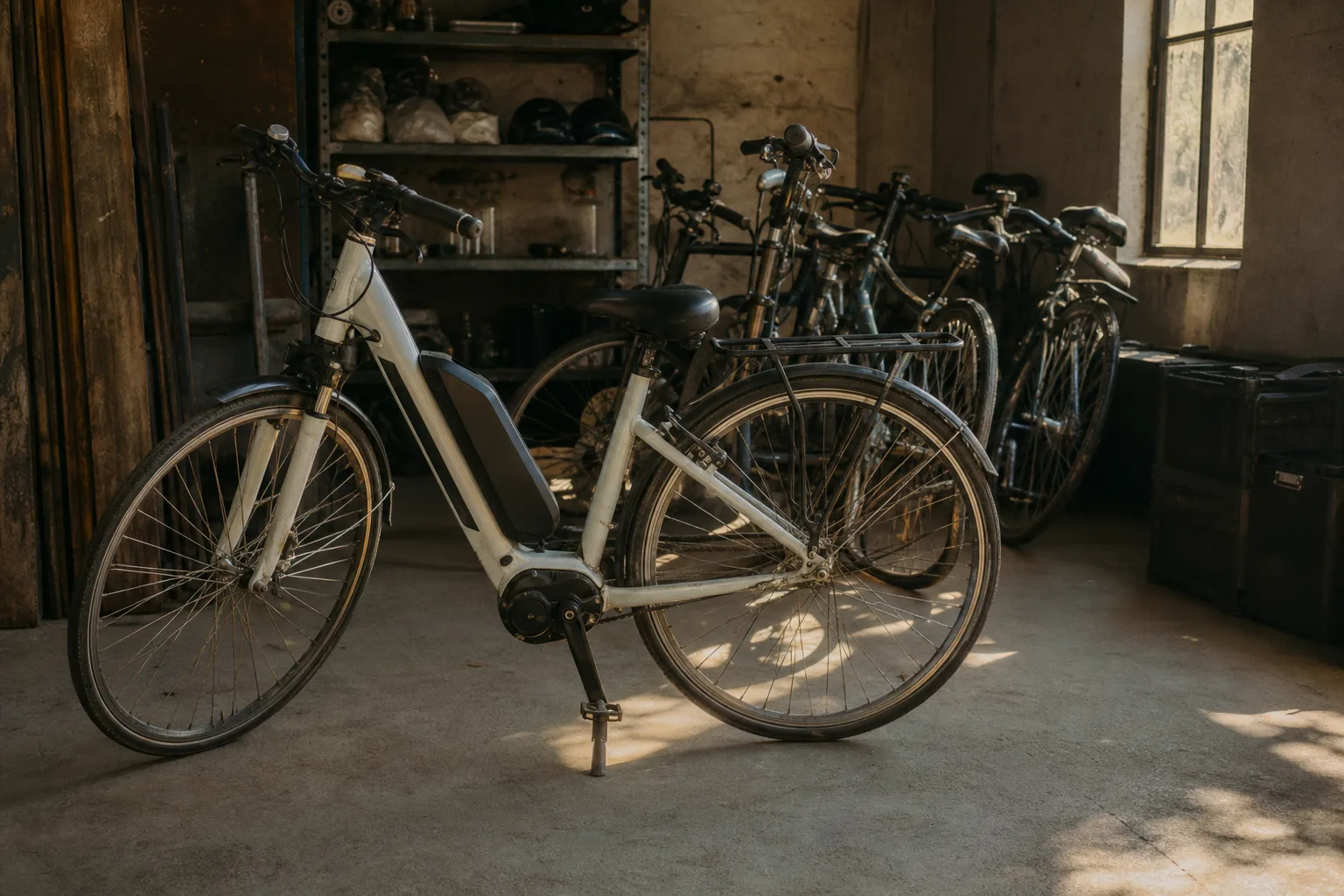
How to convert a battery's watt-hour rating into honest city mileage for a heavy rider with cargo, and how to choose charging and storage habits you can live with.
Two bikes sit in the same showroom with the same 500 watt-hour battery, and one is advertised at 60 miles while the other claims 28. Neither number is a lie, exactly, and neither is useful without the assumptions that produced it. The larger figure almost always describes a light rider on flat pavement at the lowest assist setting, pedaling hard, in still air, on a fully charged new pack. The smaller figure usually comes from a manufacturer that tested at a middle assist level with a realistic load. A careful reader checks which of those two stories the number is telling before comparing anything else.
Watt-hours per mile, and the assumptions behind them
The only durable way to compare packs across brands is energy divided by consumption: watt-hours in the battery, watt-hours drawn per mile. Consumption is not a fixed property of the bike, it is a property of the whole system, meaning rider weight, cargo, tire pressure, hills, stop frequency, temperature, and above all how much of the work the motor is doing rather than your legs. A light rider spinning on minimal assist may sit near the bottom of the plausible range. A two hundred and forty pound rider with thirty pounds of groceries, riding on the highest assist because that is what the setting is for, sits near the top, sometimes double.
Run the arithmetic yourself with a stated assumption rather than accepting a headline. If you assume twenty watt-hours per mile, a 500 watt-hour pack yields twenty-five miles. If your real-world figure turns out to be thirty, the same pack yields under seventeen. Wind is the term people underestimate: air resistance climbs steeply with speed, so a persistent headwind on a bridge approach or an open avenue costs far more than the same distance sheltered by buildings. Cold does something different, temporarily reducing the energy a pack will deliver, which returns when the cell warms.
Sizing the pack against the trip you actually take
For a two-mile errand repeated four times a day, almost any modern pack is oversized, and the relevant comparison shifts to weight, price, and how easily the battery comes off the frame. For a seven-mile commute each way with a hill and no charging at the destination, the honest planning number is your worst case, not your average, because running the pack flat on the return leg means pedaling forty-odd pounds of bicycle home. A useful discipline is to size for roughly two-thirds of your calculated range, which absorbs headwind, cold mornings, and the gradual capacity loss every lithium pack shows after a few hundred cycles.
That reserve also buys you a gentler charging habit. Packs generally age faster when routinely held at a full charge or run to empty, so a bike that finishes the day at forty percent and gets topped to eighty gives you both a margin and a longer service life. The trade is convenience against longevity, and it is a real trade rather than a free lunch.
Certification, and where the pack spends the night
The Consumer Product Safety Commission oversees the safety of consumer products including electric bicycle batteries and chargers, and its interest in this category has pushed the market toward third-party certification. What a careful buyer looks for is a listing mark covering the specific product: UL 2271 addresses the battery pack, UL 2849 addresses the complete electrical system of the bicycle, charger and controller included. A cell brand named in the spec sheet is a good sign. A claim that the bike uses "UL cells" without a listing number for the pack or the system is not the same thing, and several apartment buildings and insurers now ask for the listing explicitly.
Where the pack sits overnight follows from that. A removable battery lets you charge in a room you occupy, on a hard surface, away from the door you would use to leave, rather than in a shared hallway where a building may prohibit it outright and where nobody is watching. An integrated battery means the whole bicycle comes upstairs or the bike stays somewhere with a licensed outlet, so a fourth-floor walk-up quietly makes removability the deciding feature. Charge with the supplied charger, unplug when the light turns, and store at a partial charge in a room that stays close to comfortable.
Buy the pack that covers your worst day at a middle assist level, insist on a listing mark for the system rather than the cells, and pick a mounting arrangement that matches the stairs you actually climb.